
Direct-View Fine-Pitch LED vs. LCD Video Walls
An engineering evaluation of optical contrast, seam grid interference, thermal dissipation, 10-year total cost of ownership (TCO), and architectural maintenance access for commercial deployments.
Evaluating Visual Technology for Large Canvas Displays
When engineering large-scale visualization canvases for corporate lobbies, executive boardrooms, retail flagships, or emergency control rooms, system designers primarily evaluate two mature technologies: Direct-View Fine-Pitch LED and Ultra-Narrow Bezel LCD Video Walls.
While LCD video walls historically offered superior pixel density at lower initial capital expenditure, recent advancements in Surface-Mounted Device (SMD) and Chip-on-Board (COB) fine-pitch LED manufacturing have dramatically narrowed the cost gap while offering genuine advantages in optical performance, lifespan, and seamless continuity.
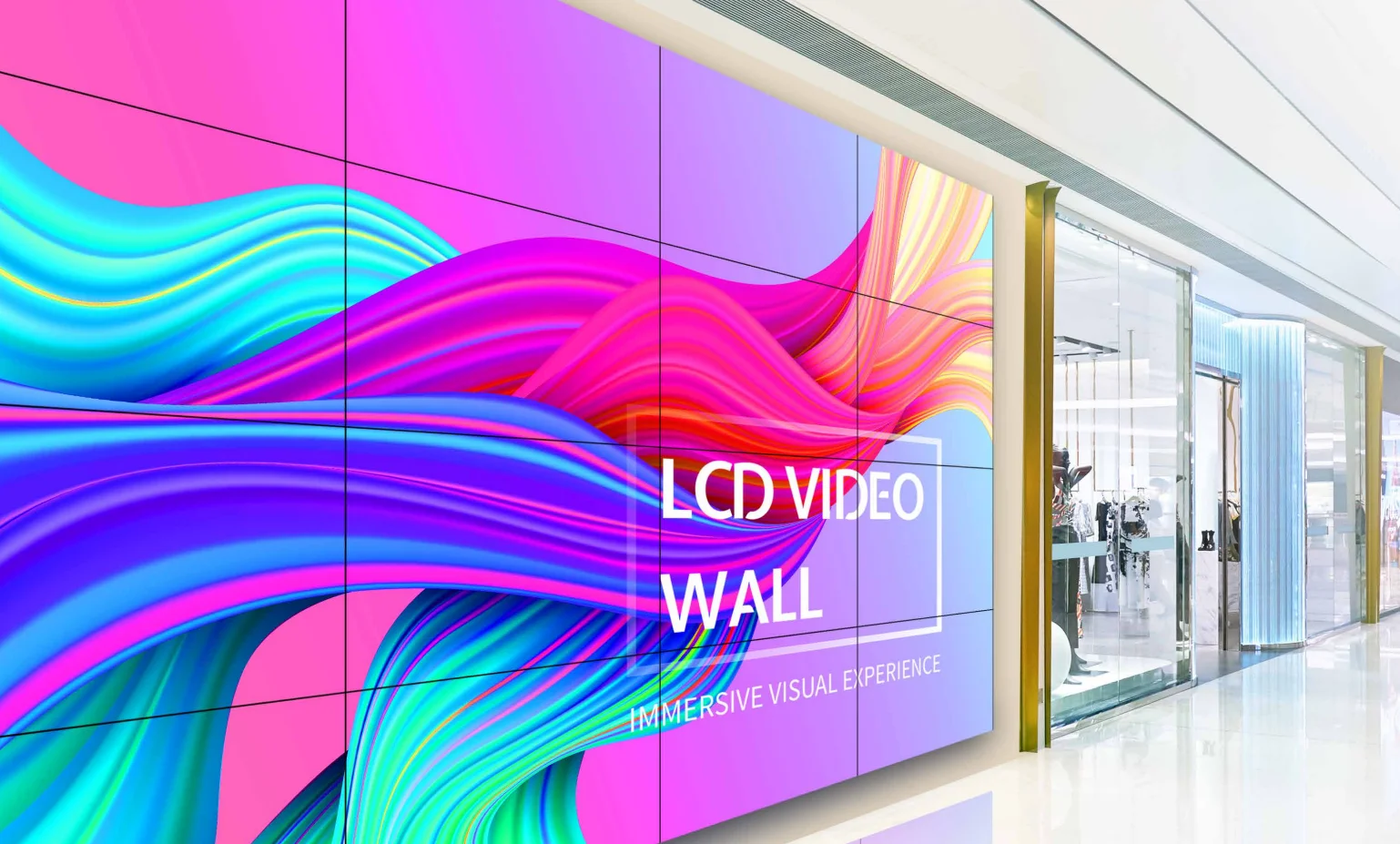
- Optical Continuity: LED creates an uninterrupted monolithic pixel grid, whereas LCD arrays inherently introduce bezel grid seams (0.88mm to 3.5mm combined).
- Dynamic Range & True Black: Direct-view LEDs act as emissive pixels that turn completely off, achieving contrast ratios exceeding 5,000:1 compared to LCD backlight bleed.
- Service Modularity: LED modules are 100% front-serviceable with magnetic vacuum tools, avoiding the mechanical complexity of extracting a center LCD panel from a 4x4 matrix.
Engineering Parameters: LED vs. LCD
Direct side-by-side comparison across optical, mechanical, and operational dimensions.
| Evaluation Parameter | Fine-Pitch Direct-View LED | Ultra-Narrow Bezel LCD Wall |
|---|---|---|
| Seam Visibility | Zero seams (100% continuous optical surface) | 0.88mm, 1.74mm, or 3.5mm combined bezel grid |
| Peak Luminance (Brightness) | 600 – 1,200 nits (Indoor); up to 10,000 (Outdoor) | 500 – 700 nits (Fixed backlight) |
| Contrast Ratio | 5,000:1 to 10,000:1 (True deep blacks) | 1,100:1 to 1,300:1 (Backlight glow in dark scenes) |
| Color Uniformity & Degradation | Single-pixel calibration; uniform diode aging | CCFL/LED edge backlights age at different rates |
| Operational MTBF Lifespan | 100,000 hours to half-brightness | 50,000 – 60,000 hours (Backlight degradation) |
| Heat Generation & Power | Proportional to content brightness (Common Cathode) | Constant backlight draw regardless of black content |
| Service Access & Maintenance | Front magnetic extraction of single 150mm tile | Hydraulic pop-out bracket required; fragile glass edges |
| Viewing Angle Uniformity | 160° horizontal / 160° vertical with zero color shift | 178° viewing angle, but minor color fade at extreme off-axis |
| Initial Capital Cost (CapEx) | Higher initial capital investment | Lower initial purchase price per square meter |
| 10-Year Total Cost of Ownership | Lower TCO due to modular tile repair and 100k hr life | Higher TCO due to panel replacements and color mismatch |
When to Specify LED vs. When to Specify LCD
Clear project criteria based on viewing distance, budget, and operational profile.
When to Choose Fine-Pitch LED
- No Bezel Interruptions: Applications displaying complex geospatial maps, financial spreadsheets, or broadcast cameras where grid lines are unacceptable.
- High-Ambient Daylight: Atriums, glass lobbies, or retail storefronts with ambient light exceeding 1,000 lux.
- Custom Aspect Ratios & Curves: Non-standard ultra-wide banners, 90° corner columns, or concave video walls.
- Long-Term 24/7 Operations: Facilities requiring 7+ years of continuous service without replacing entire display panels.
When to Choose LCD Video Walls
- Budget Constrained CapEx: Projects with strict initial equipment budgets where cost per square meter is paramount.
- Standard 16:9 Multi-Screen Matrices: 2x2 or 3x3 configurations where each panel natively displays a distinct Full HD camera or dashboard.
- Controlled Ambient Lighting: Darkened control rooms or basement operations where 500 nits brightness is entirely sufficient.
- Very Close Viewing on Small Walls: When viewing from under 1 meter and budget precludes 0.9mm micro-pitch LED.